Types of Shaft Couplings: How They Work and How to Choose
Almost every rotating machine has at least one point where two shafts need to be connected, such as a motor driving a pump, a gearbox driving a conveyor, or a motor driving a fan. The component that makes that connection is a shaft coupling. It transmits torque from one shaft to the other and, depending on its design, can also accommodate misalignment, absorb shock loads, and reduce vibration.
Choosing the wrong coupling can lead to premature bearing wear, seal failures, excessive vibration, and unplanned downtime. In this guide, we'll explain how shaft couplings work, compare the main coupling types, and highlight what to check when adding couplings to your designs, with links to manufacturer-certified shaft coupling CAD models in the HVH Designer library.
What Does a Shaft Coupling Do?
A shaft coupling connects two shafts so they rotate together. Its main jobs are to:
-
Transmit torque from the driving shaft to the driven shaft
-
Accommodate misalignment between shafts, depending on the coupling type
-
Absorb shock and dampen vibration, particularly with elastomeric designs
-
Allow easier maintenance, by letting connected equipment be separated and serviced
Understanding Shaft Misalignment
No two shafts are ever perfectly aligned, and alignment can shift further due to temperature changes, settling, and wear. Couplings are often selected based on how much misalignment they can handle. There are three main types:
-
Angular misalignment: the shaft centerlines meet at an angle
-
Parallel (offset) misalignment: the shafts are parallel but offset from each other
-
Axial misalignment: the shafts move closer together or farther apart along their length
Even flexible couplings have limits, so proper shaft alignment during installation is still essential.
Rigid vs Flexible Couplings
Shaft couplings fall into two broad groups.
Rigid couplings connect shafts firmly, with no allowance for misalignment. They're simple and precise, but require very accurate alignment.
Flexible couplings accommodate some degree of misalignment and, in many designs, absorb shock and vibration. Most industrial drive applications use some form of flexible coupling, which includes gear, grid, jaw, tire, and pin and bush couplings.
Types of Shaft Couplings
Rigid Couplings
Rigid couplings create a solid connection between two shafts, effectively turning them into a single rotating unit. Common designs include sleeve, flange, clamp, and cone clamping couplings.
Because they don't flex, rigid couplings provide accurate torque transmission with no backlash, but they offer no protection against misalignment. Any offset between the shafts transfers directly into bearings and seals, so they're best suited to applications where shafts are precisely aligned and well supported.
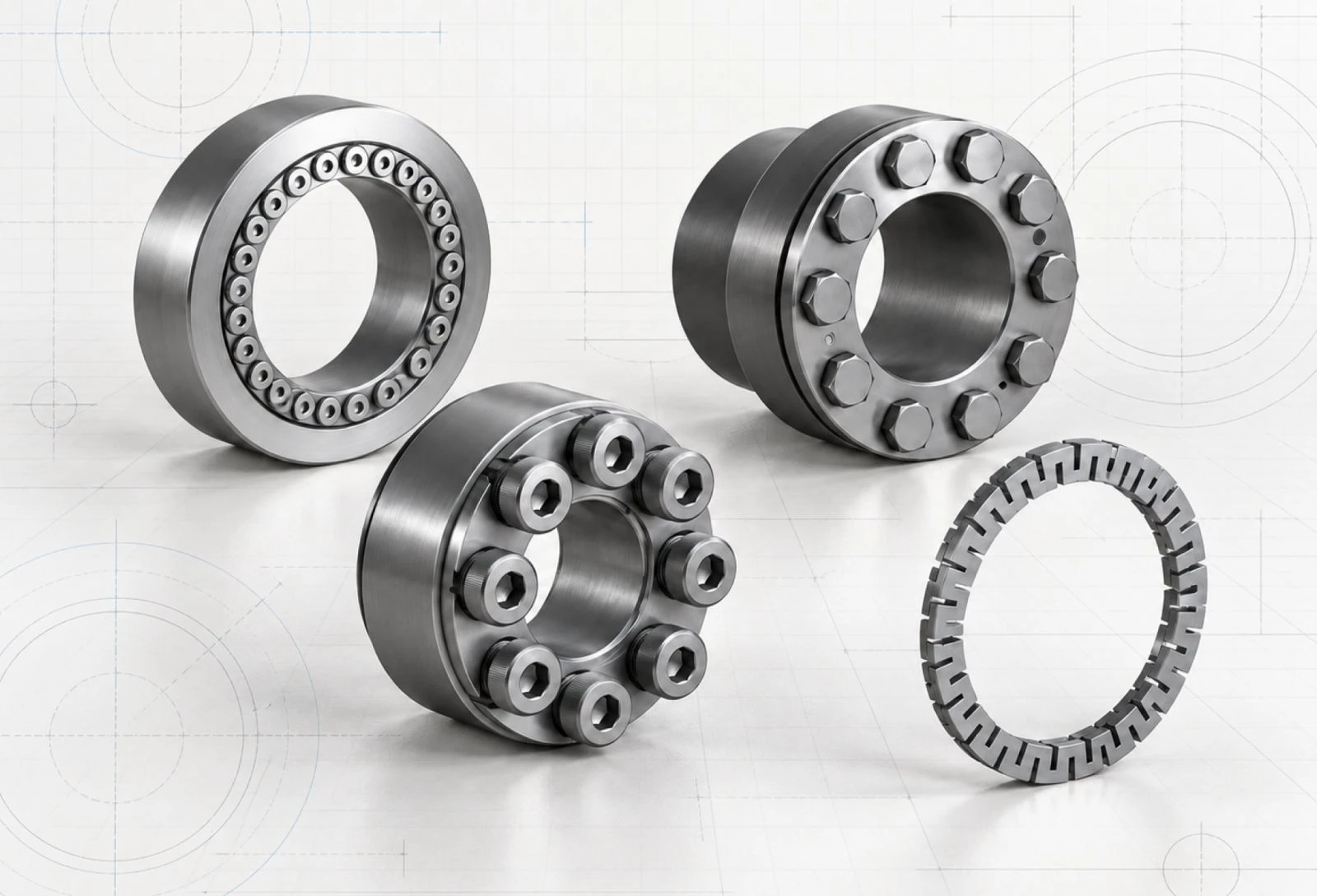
Cone clamping couplings use tapered clamping elements to grip the shafts through friction, creating a keyless, backlash-free connection. Explore models in Cone Clamping Couplings RWK… EEO.
Flexible Couplings
Flexible couplings connect shafts while accommodating misalignment. Many use elastomeric elements that also absorb shock and dampen vibration, reducing stress on motors, gearboxes, and bearings.
Elastomeric sleeve couplings, for example, use a flexible sleeve between two flanged hubs, giving a compact, lubrication-free design that handles misalignment and shock loads. Explore models in Lovejoy S-Flex Endurance Couplings.
Gear Couplings
Gear couplings use two hubs with external gear teeth that mesh with internal teeth inside a sleeve. Crowned teeth allow the coupling to accommodate angular misalignment, and double-engagement designs can also handle parallel offset.
Gear couplings are known for their high torque capacity relative to their size, making them a common choice for heavy-duty applications such as steel mills, mining equipment, and large pumps and compressors. They typically require periodic lubrication to prevent tooth wear. Explore models in Falk Lifelign Gear Couplings.
Grid Couplings
Grid couplings connect two grooved hubs with a flexible, serpentine-shaped spring steel grid. As torque increases, the grid flexes and contacts more of the hub teeth, which helps absorb shock loads and reduce vibration.
Grid couplings combine high torque capacity with torsional flexibility, making them popular in conveyors, crushers, fans, and pumps. They require lubrication and are enclosed in a cover to retain grease. Explore models in Falk Steelflex Grid Couplings and LoveJoy Grid Couplings.
Pin and Bush Couplings
Pin and bush couplings connect two hubs using pins fitted with elastomeric bushes or buffers. The elastomer elements provide flexibility, absorb shock, and dampen vibration while transmitting torque.
These couplings are widely used in general industrial drives, including pumps, compressors, and conveyors, and the elastomer elements can typically be replaced during maintenance. Explore models in Flender N-EUPEX Pin Couplings.
Tire Couplings
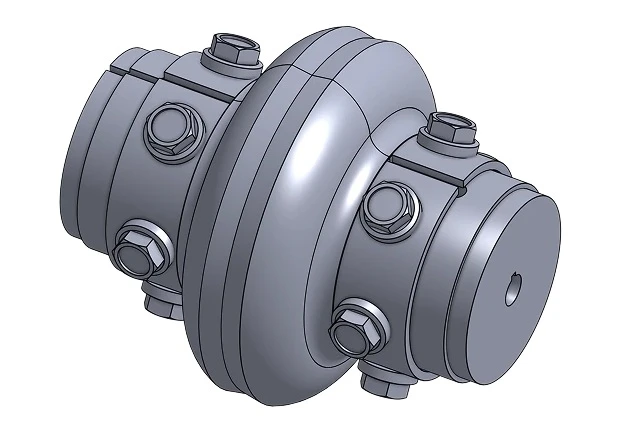
Tire couplings use a flexible, tire-shaped elastomer element to connect two hubs. This design accommodates relatively large amounts of misalignment and provides excellent shock absorption and vibration damping, without requiring lubrication.
Many tire couplings use a split element that can be replaced without moving the connected equipment, which simplifies maintenance. Explore models in Rexnord Viva Elastomeric Couplings and Omega Tire Couplings.
Jaw Couplings
Jaw couplings consist of two hubs with interlocking jaws and an elastomeric insert, called a spider, between them. The spider transmits torque, absorbs shock, and accommodates small amounts of misalignment.
Jaw couplings are compact, require no lubrication, and are easy to install, making them one of the most common choices for small to medium motor-driven equipment such as pumps, fans, and conveyors. In many designs, the jaws continue to engage if the spider fails, allowing the equipment to keep running until it can be serviced. Explore models in Standard Jaw Couplings.
How to Choose the Right Coupling
Consider these factors when selecting a shaft coupling:
Torque: Size the coupling for the application's torque, including an appropriate service factor for shock loads and starting conditions.
Speed: Confirm the coupling's maximum rated speed. Higher speeds may require balanced couplings.
Misalignment: Choose a coupling that can handle the expected angular, parallel, and axial misalignment.
Shaft sizes: Check that the hub bore range fits both shafts, including keyway requirements.
Shock and vibration: Elastomeric couplings such as jaw, tire, and pin and bush designs help dampen vibration and protect connected equipment.
Maintenance: Gear and grid couplings typically need periodic lubrication, while elastomeric couplings are often maintenance-free apart from element replacement.
Environment: Temperature, chemicals, moisture, and dust can affect elastomers and lubricants, so match materials to the operating conditions.
Shaft Couplings in CAD Design
When adding a coupling to your assembly, a few details help prevent problems later:
-
Bore sizes and keyways must match both connected shafts.
-
Distance between shaft ends (DBSE) must suit the coupling's design.
-
Overall diameter and length determine the space needed, including room for a coupling guard.
-
Installation and maintenance access should allow hubs to be mounted, elements replaced, and alignment checked.
Using manufacturer-certified coupling CAD models in HVH Designer lets you check these dimensions directly in your assembly before ordering parts.
Frequently Asked Questions
What are the main types of shaft couplings?
The main types include rigid, flexible, gear, grid, pin and bush, tire, and jaw couplings.
What is the difference between rigid and flexible couplings?
Rigid couplings connect shafts with no allowance for misalignment, while flexible couplings accommodate misalignment and often absorb shock and vibration.
Which couplings don't need lubrication?
Elastomeric couplings, such as jaw, tire, and many flexible sleeve couplings, typically don't require lubrication. Gear and grid couplings usually do.
Can a flexible coupling replace proper shaft alignment?
No. Flexible couplings tolerate some misalignment, but accurate alignment is still essential to reduce wear on bearings, seals, and the coupling itself.
Conclusion
Shaft couplings may be small components, but they play a major role in the reliability of rotating equipment. Rigid couplings offer precise connections for well-aligned shafts, while flexible designs such as gear, grid, pin and bush, tire, and jaw couplings accommodate misalignment and protect connected equipment from shock and vibration. By matching the coupling to your torque, speed, misalignment, and maintenance requirements, and checking its dimensions in your CAD assembly, you can build drives that run smoothly and last longer.