Keyless Locking Devices: Types, Benefits, and How They Work
Gears, pulleys, sprockets, and couplings all need to be securely fixed to a shaft. For decades, the standard solution has been a key and keyway. It works, but machining a keyway creates a stress concentration in the shaft, can introduce backlash, and makes precise positioning difficult. Over time, keys can also wear and loosen.
Keyless locking devices take a different approach. They connect shafts to hubs using friction rather than keys or splines, creating a backlash-free connection that's easier to assemble, adjust, and remove. In this guide, we'll explain how they work, compare the main types, and share what to check when adding them to your designs, with links to free keyless locking device CAD models in the HVH Designer library.
What Is a Keyless Locking Device?
A keyless locking device clamps a hub to a shaft using radial pressure. Most designs rely on tapered surfaces: when screws or an axial force are applied, the tapers slide against each other, generating radial pressure between the shaft and hub. The resulting friction creates a connection similar to a shrink fit, without heating or pressing.
Benefits of Keyless Connections
Compared with traditional keyed connections, keyless locking devices can offer several advantages:
-
No keyway machining, avoiding the stress concentration a keyway creates in the shaft
-
Backlash-free connections, suited to reversing, indexing, and precision applications
-
Flexible positioning, since hubs can be set at any angle or axial position
-
Simpler installation and removal, often with standard hand tools
-
Reusability for many designs, depending on their condition and the manufacturer's guidance
Load capacity depends on the specific device, shaft and hub design, and operating conditions, so selection should always be based on the manufacturer's data.
Types of Keyless Locking Devices
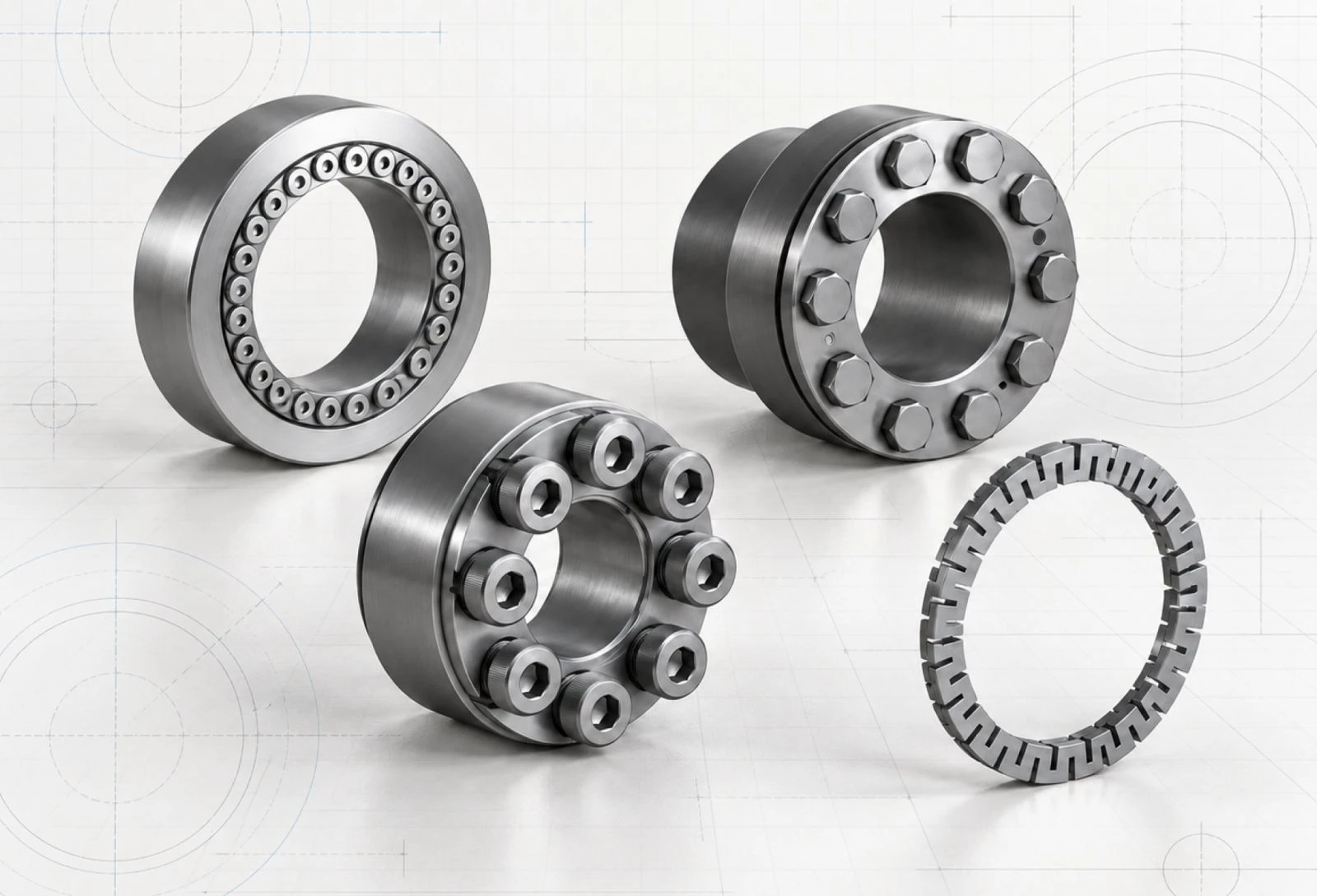
Shrink Discs
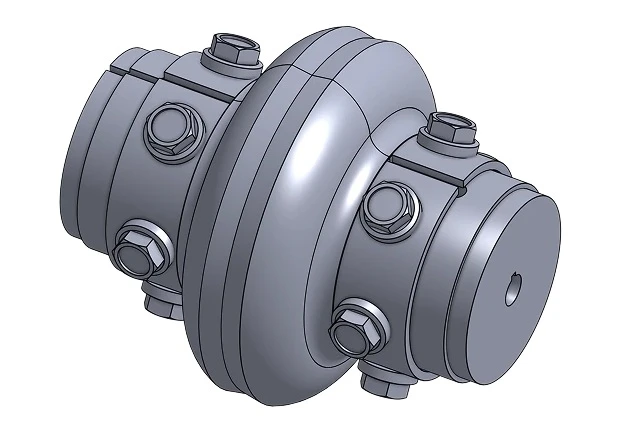
Shrink discs are mounted on the outside of a hub, typically a hollow shaft or hub sleeve. As the screws are tightened, tapered rings are drawn together, applying external pressure that compresses the hub onto the shaft.
The shrink disc creates the clamping force, while torque is transmitted by friction at the shaft-to-hub interface rather than through the shrink disc itself. Shrink discs are widely used for shaft-mounted gearboxes, hollow-shaft drives, and large rotating equipment, and are available in two-part and three-part designs from manufacturers such as Ringfeder.
Locking Assemblies
Locking assemblies fit between the shaft and the hub bore. They typically consist of inner and outer tapered rings drawn together by axial screws. As the screws are tightened, the inner ring contracts onto the shaft while the outer ring expands into the hub, locking the components together.
Locking assemblies are among the most versatile keyless solutions, used to mount gears, pulleys, sprockets, couplings, and conveyor pulleys. Designs vary in torque capacity, and some are self-centering, which helps maintain concentricity between the hub and shaft.
Locking Elements
Locking elements use tapered surfaces to generate radial clamping pressure between a shaft and hub. Depending on the design, they may rely on separate clamping hardware, such as a pressure flange and screws built into the hub assembly, or an integrated screw arrangement.
Their compact size makes them useful where space is limited, and they're common in compact drives, machine components, and custom hub designs.
Star Discs
RINGSPANN Star Discs are slotted, conical discs that convert an applied axial force into a higher radial clamping force to secure a shaft-hub connection. Multiple discs can be arranged in a pack to suit the required torque capacity.
Star discs are compact and well suited to smaller shaft-hub connections and precision mechanisms where space is tight. They're available from RINGSPANN, a manufacturer of shaft-hub connections and power transmission components.
How to Choose the Right Keyless Locking Device
Torque and load: Select a device that can transmit the required torque, plus any axial or bending loads, with an appropriate safety margin based on the manufacturer's data.
Shaft and hub dimensions: Confirm the shaft diameter, hub bore, and hub length meet the manufacturer's requirements, including specified tolerances and surface finish.
Hub strength: Keyless devices generate high radial pressure, so the hub needs sufficient wall thickness to withstand it without deforming.
Concentricity: For precise applications, consider self-centering designs.
Space constraints: Choose between external shrink discs, internal locking assemblies, compact locking elements, or star discs based on the available space.
Environment: In corrosive or washdown environments, consider stainless steel or coated versions.
Installation Tips
-
Follow the manufacturer's tightening sequence, tightening screws gradually and evenly in several passes.
-
Use a calibrated torque wrench to reach the specified tightening torque.
-
Prepare contact surfaces exactly as the manufacturer specifies. Lubrication requirements vary by design, and using the wrong lubricant on a friction-based connection can reduce its torque capacity.
-
Check alignment before final tightening to keep the hub square and concentric.
-
Follow the manufacturer's release procedure when removing the device.
Keyless Locking Devices in CAD Design
When adding a keyless locking device to your assembly, check the shaft and hub bore dimensions, the hub length and wall thickness needed for clamping, the clearance around the screws for a torque wrench, and the overall envelope, especially for externally mounted shrink discs.
HVH Designer provides free keyless locking device CAD models in STEP format, so you can check fit and clearance directly in your assembly before ordering parts.
Frequently Asked Questions
What is the difference between a shrink disc and a locking assembly?
A shrink disc mounts on the outside of a hub and compresses it onto the shaft, while a locking assembly fits between the shaft and hub bore.
Are keyless locking devices reusable?
Many are, depending on the design and condition of the components. Follow the manufacturer's guidance.
Do keyless locking devices need lubrication?
It depends on the design. Some require lightly oiled contact surfaces, while certain lubricants can reduce torque capacity, so always follow the manufacturer's instructions.
Where can I download keyless locking device CAD models?
HVH Designer offers free STEP models of shrink discs, locking assemblies, locking elements, and star discs.
Conclusion
Keyless locking devices offer a backlash-free alternative to keyed shaft-hub connections, with flexible positioning and simpler installation. Shrink discs, locking assemblies, locking elements, and star discs each suit different space, load, and design requirements. Choosing the right device based on manufacturer data and installing it correctly helps ensure a reliable connection throughout the life of the equipment.