'%3e%3cpath%20d='M19.3359%2018.2109L14.7344%2013.6094C15.875%2012.2188%2016.5625%2010.4375%2016.5625%208.49609C16.5625%204.04297%2012.9492%200.429688%208.49609%200.429688C4.03906%200.429688%200.429688%204.04297%200.429688%208.49609C0.429688%2012.9492%204.03906%2016.5625%208.49609%2016.5625C10.4375%2016.5625%2012.2148%2015.8789%2013.6055%2014.7383L18.207%2019.3359C18.5195%2019.6484%2019.0234%2019.6484%2019.3359%2019.3359C19.6484%2019.0273%2019.6484%2018.5195%2019.3359%2018.2109ZM8.49609%2014.957C4.92969%2014.957%202.03125%2012.0586%202.03125%208.49609C2.03125%204.93359%204.92969%202.03125%208.49609%202.03125C12.0586%202.03125%2014.9609%204.93359%2014.9609%208.49609C14.9609%2012.0586%2012.0586%2014.957%208.49609%2014.957Z'%20fill='%23535B62'/%3e%3c/g%3e%3cdefs%3e%3cclipPath%20id='clip0_12799_29299'%3e%3crect%20width='20'%20height='20'%20fill='white'/%3e%3c/clipPath%3e%3c/defs%3e%3c/svg%3e)

PDM vs. PLM
Ask an engineering team if they need "PLM" and you'll often get a confident yes, even when what they actually need is PDM. The two terms get used almost interchangeably in casual conversation, but they solve genuinely different problems, at genuinely different scales. Getting this distinction right matters, because buying full PLM when you only need PDM means paying for, and maintaining, a system far bigger than your team actually requires. Buying PDM when you need PLM means outgrowing your tools within a year.
What Is PDM (Product Data Management)?
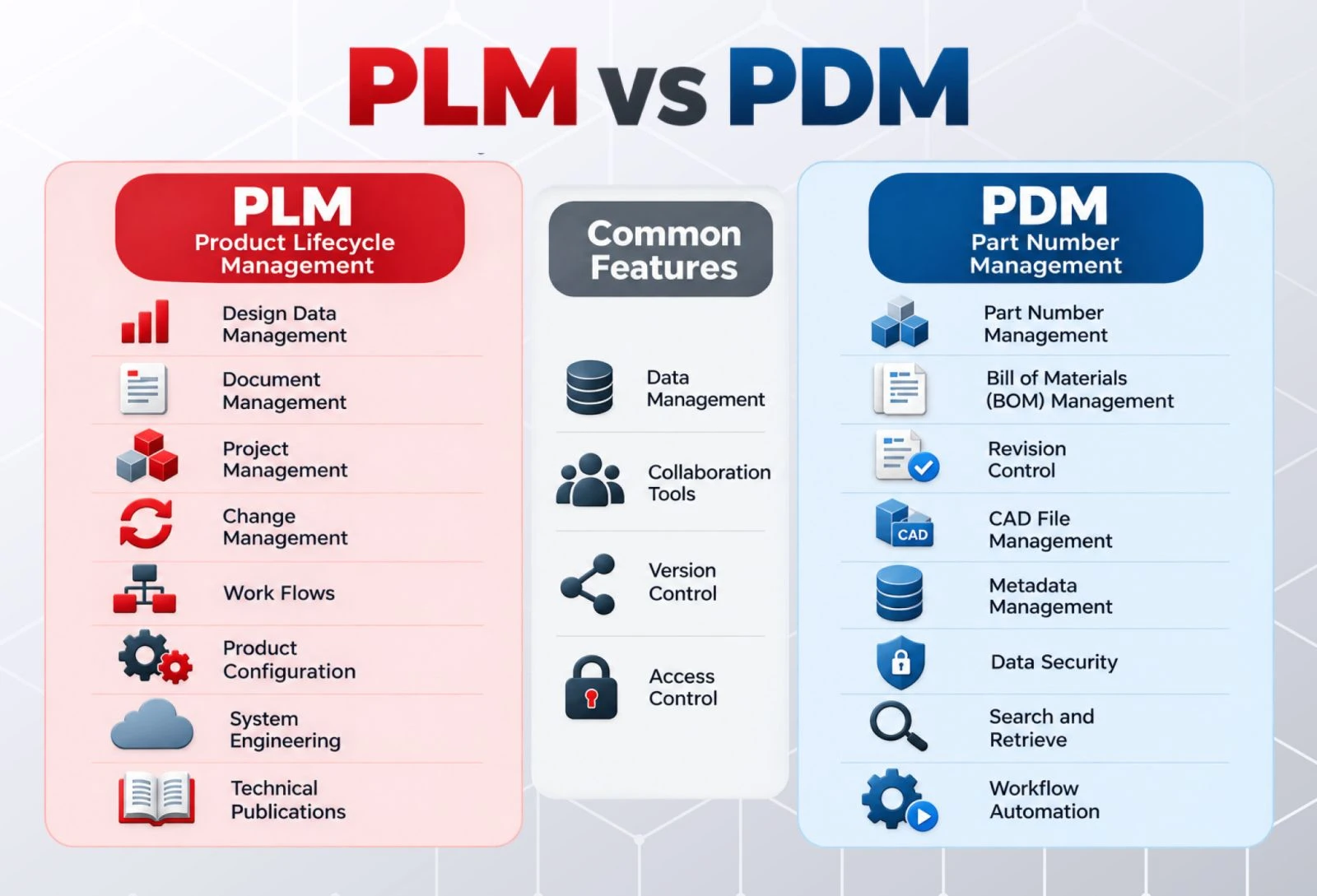
PDM is software focused on managing engineering data, specifically CAD files, revisions, and the access controls around them. Its job is to make sure the right person is working on the right version of a design, that changes are tracked, and that files don't get overwritten, lost, or duplicated as a team collaborates on an assembly.
Common PDM tools include SOLIDWORKS PDM and Autodesk Vault, both built primarily to sit on top of a specific CAD ecosystem and manage the engineering file structure within it. PDM's scope is intentionally narrow: it lives almost entirely inside the engineering department, handling things like check-in/check-out workflows, revision history, engineering bills of materials (EBOMs), and basic engineering change tracking.
What Is PLM (Product Lifecycle Management)?
PLM manages a much broader scope: the entire lifecycle of a product, from initial concept and requirements through design, manufacturing, quality, service, and eventual retirement. Where PDM answers "what's the current revision of this CAD file?", PLM answers questions that span far beyond engineering, like how a design change affects manufacturing cost, which suppliers are approved for a given part, or how a product's compliance documentation needs to update alongside a design revision.
Common PLM platforms include PTC Windchill, Siemens Teamcenter, and Arena PLM, and they typically integrate engineering data with manufacturing, supply chain, quality, and sometimes ERP systems, connecting departments that a standalone PDM tool was never designed to reach.
The Core Difference: Scope, Not Just Features
The clearest way to frame the difference isn't a feature checklist, it's scope. PDM manages engineering data. PLM manages the product itself, across its entire life, of which engineering data is only one piece. In fact, PDM functionality, revision control, file management, access permissions, is often built directly into a PLM system as one of its many modules. PDM is frequently a subset of PLM, not a competing category.
PDM vs. PLM at a Glance
-
PDM — Manages CAD files, revisions, and access control within engineering. Examples: SOLIDWORKS PDM, Autodesk Vault.
-
PLM — Manages the full product lifecycle across engineering, manufacturing, quality, and supply chain. Examples: PTC Windchill, Siemens Teamcenter, Arena PLM.
-
Relationship — PDM is typically a subset of PLM's broader capability, not a separate, competing system.
Which One Does Your Team Actually Need?
For a small to mid-sized engineering team whose main pain point is version control, keeping track of who changed what CAD file and when, PDM alone is usually sufficient, and far simpler to implement and maintain than a full PLM rollout.
PLM becomes the right call once a product's complexity extends well beyond engineering: multiple departments need visibility into design changes, supply chain and compliance data need to stay synchronized with revisions, or a company manages multiple product lines with overlapping components and suppliers. At that point, the cross-departmental coordination PLM provides starts delivering real value that PDM alone was never built to offer.
Conclusion
PDM and PLM aren't two versions of the same thing, they operate at different scales entirely. PDM keeps engineering data organized and version-controlled. PLM manages a product's entire journey from concept to retirement, often with PDM functionality built in as one piece of that larger system. Most teams don't actually need to choose between "PDM" and "PLM" as competing options, they need to honestly assess how far beyond engineering their coordination problems actually extend, and select a system that matches that real scope, not the one with the more impressive-sounding name.