'%3e%3cpath%20d='M19.3359%2018.2109L14.7344%2013.6094C15.875%2012.2188%2016.5625%2010.4375%2016.5625%208.49609C16.5625%204.04297%2012.9492%200.429688%208.49609%200.429688C4.03906%200.429688%200.429688%204.04297%200.429688%208.49609C0.429688%2012.9492%204.03906%2016.5625%208.49609%2016.5625C10.4375%2016.5625%2012.2148%2015.8789%2013.6055%2014.7383L18.207%2019.3359C18.5195%2019.6484%2019.0234%2019.6484%2019.3359%2019.3359C19.6484%2019.0273%2019.6484%2018.5195%2019.3359%2018.2109ZM8.49609%2014.957C4.92969%2014.957%202.03125%2012.0586%202.03125%208.49609C2.03125%204.93359%204.92969%202.03125%208.49609%202.03125C12.0586%202.03125%2014.9609%204.93359%2014.9609%208.49609C14.9609%2012.0586%2012.0586%2014.957%208.49609%2014.957Z'%20fill='%23535B62'/%3e%3c/g%3e%3cdefs%3e%3cclipPath%20id='clip0_12799_29299'%3e%3crect%20width='20'%20height='20'%20fill='white'/%3e%3c/clipPath%3e%3c/defs%3e%3c/svg%3e)

CAD and Machinability: Designing for Manufacturing
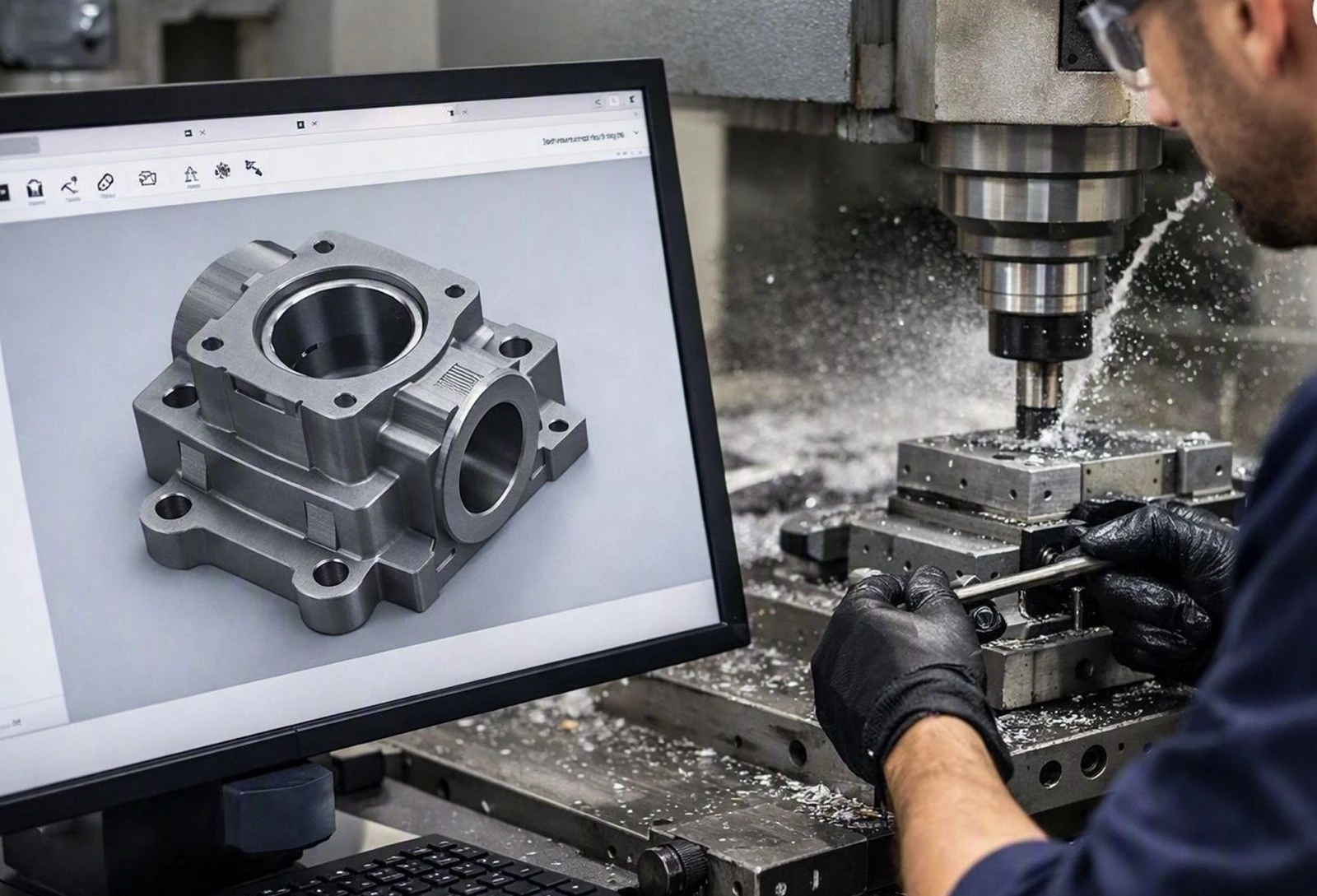
Computer-Aided Design (CAD) has revolutionized engineering by allowing precise digital models of parts and assemblies. But a design is only successful if it can be manufactured efficiently. This is where machinability comes into play. Machinability refers to how easily a material can be cut, shaped, or finished, and CAD provides the tools to design parts that respect machining realities.
What Is Machinability?
Machinability is the measure of how a material responds to machining operations. It considers cutting forces, tool wear, chip formation, surface finish, specialized tools and slower cutting speeds.
CAD's Role in Machinability
CAD systems allow engineers to design parts with machinability in mind by:
-
Avoiding sharp internal corners that are difficult to machine with round cutting tools
-
Minimizing deep cavities that require long, flexible tools prone to vibration
-
Ensuring tool accessibility by designing features that can be reached with standard cutters
-
Specifying tolerances wisely, avoiding unnecessarily tight tolerances that increase machining time and cost
-
Selecting materials from CAD libraries with machinability ratings to balance performance and ease of cutting
Examples of Designs That Can Be Machined
Gear Housing With Rounded Fillets
Instead of sharp corners, fillets are added to match cutter geometry, reducing tool stress and improving surface finish.
Bracket With Standard Hole Sizes
Holes are designed to match standard drill diameters (e.g., 6 mm, 8 mm, 10 mm), avoiding custom tooling.
Shaft With Chamfered Edges
Chamfers ease assembly and reduce burr formation, making machining faster and cleaner.
Pocket With Accessible Tool Paths
A rectangular pocket designed with open ends allows end mills to cut efficiently without requiring special slotting tools.
Component With Symmetry
Symmetrical designs reduce setup changes, allowing machining from fewer orientations.
Benefits of Designing for Machinability
-
Reduced production time — efficient tool paths and accessible features shorten machining cycles
-
Lower costs — less tool wear and fewer custom cutters reduce expenses
-
Improved quality — predictable chip formation and smoother finishes ensure parts meet specifications
-
Better collaboration — CAD models that respect machinability make communication between design and manufacturing teams seamless
Why Good Design Is Not Necessarily a Machinable Design
A good design in terms of function, aesthetics, or performance does not automatically mean it is a machinable design. This is one of the most important lessons in mechanical engineering: a design must balance functionality with manufacturability.
Complex Geometry
A design may look elegant in CAD but require impossible tool paths or custom tooling that makes machining impractical.
Tight Tolerances
Over-specifying tolerances (e.g., ±0.001 mm where ±0.05 mm is sufficient) makes machining unnecessarily expensive and slow.
Material Choice
A design in hardened steel or exotic alloys may meet performance goals but be extremely difficult to machine, leading to tool wear and high costs.
Accessibility
Features hidden deep inside a part may be impossible to reach with standard cutters, even if the design itself is technically sound.
What Makes a Design Machinable
A machinable design is one that:
-
Uses standard hole sizes, threads, and radii that match available tools
-
Avoids sharp internal corners, replacing them with fillets that match cutter geometry
-
Keeps features accessible from common machining orientations
-
Specifies realistic tolerances based on the manufacturing process capability
-
Chooses materials that balance performance with machinability
Example: Good vs. Machinable
Good but not machinable: A gearbox housing with sharp 90° internal corners and deep pockets. Looks fine in CAD but requires EDM or custom tooling. Good and machinable: The same housing redesigned with fillets, open pockets, and standard hole sizes. Functionally identical, but now machinable with standard milling tools.
Conclusion
A design can be "good" in theory but fails in practice if it ignores machining realities. Machinability is part of a good design. The best engineers integrate manufacturability into the design process from the start, ensuring that parts are not only functional but also practical to produce.